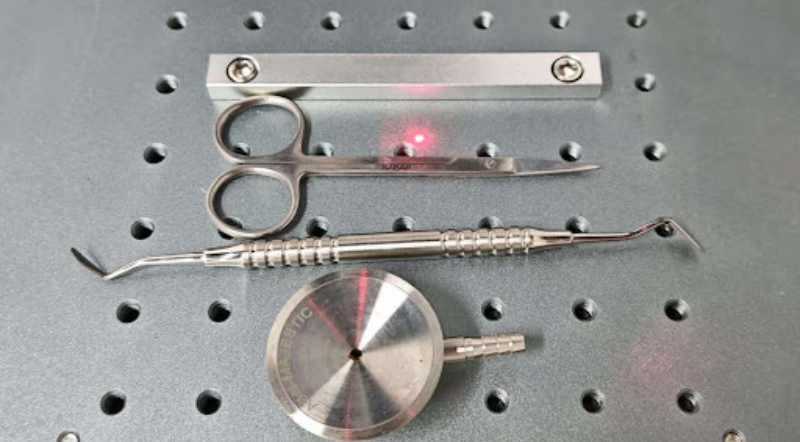
In medical manufacturing, a laser mark is not just a logo or serial number. It is part of the device’s traceability system, quality documentation, and regulatory compliance strategy. For surgical instruments, implants, reusable medical tools, and precision components, the mark must remain readable after repeated sterilisation cycles, aggressive cleaning procedures, and years of clinical use.
That is why laser marking has become the standard for medical device identification across the healthcare industry. Compared with ink printing, adhesive labels, or mechanical engraving, laser systems produce permanent, high-precision marks that can survive autoclaves, chemical sterilisation, abrasion, and long-term handling without contaminating the device surface.
For manufacturers working under FDA UDI requirements and ISO 13485 quality systems, choosing the correct laser marking process is not optional — it is a core part of compliance.
Why FDA-Compliant Laser Marking Matters
The FDA’s Unique Device Identification (UDI) system requires many medical devices to carry permanent, machine-readable identification directly on the device itself. This includes:
- Surgical instruments
- Orthopaedic implants
- Endoscopes
- Dental tools
- Reusable medical devices
- High-risk Class II and Class III products
The purpose is straightforward: every device must be traceable throughout its lifecycle.
A compliant mark may include:
- Data Matrix codes
- Serial numbers
- Lot numbers
- Manufacturing dates
- Device identifiers
- Brand or manufacturer information
In practice, the challenge is durability.
Medical tools are repeatedly exposed to:
- Steam autoclaves
- Chemical sterilisation
- Blood and saline exposure
- Abrasion during handling
- High-temperature cleaning
- Surgical disinfectants
A poor-quality mark may fade, corrode, or become unreadable — creating traceability risks during audits or recalls.
This is why laser marking systems are widely used for permanent medical identification.
The Most Common Laser Marking Methods for Medical Tools
Not all laser marks are created equally. Different medical applications require different marking techniques.
1. Laser Annealing (Preferred for Surgical Stainless Steel)
Laser annealing creates a dark oxide layer without removing material from the surface.
This is the preferred method for:
- Surgical instruments
- Stainless steel forceps
- Scalpels
- Clamps
- Titanium tools
- Reusable medical devices
Why annealing matters
Traditional engraving removes material and creates micro-recesses. In medical environments, those recesses can potentially trap contaminants or affect corrosion resistance.
Annealing avoids this problem because the surface remains smooth.
Benefits include:
- Excellent corrosion resistance
- No surface penetration
- Sterilisation resistance
- High-contrast black marks
- FDA-friendly for reusable tools
MOPA fibre lasers are especially effective for annealing because they allow pulse-duration control.
2. Laser Etching
Laser etching slightly melts the material surface to create a shallow mark.
This method is commonly used for:
- Device housings
- Non-critical components
- Medical equipment panels
- Hard polymer surfaces
Etching is fast and highly visible, but it slightly alters surface texture.
For tools exposed directly to tissue or fluids, annealing is usually preferred.
3. Deep Laser Engraving
Deep engraving physically removes material to create highly durable recessed marks.
Used for:
- Orthopaedic implants
- Titanium plates
- Abrasion-heavy components
- Industrial medical tooling
Deep engraving offers exceptional durability but must be carefully evaluated for biocompatibility and surface cleanliness.
4. UV Laser Marking for Plastics
Many medical devices use sensitive polymers that cannot tolerate heat from standard fibre lasers.
UV lasers are commonly used for:
- PEEK components
- Catheters
- Polycarbonate connectors
- Medical tubing
- Syringe components
UV systems use “cold marking” technology, reducing thermal damage and preventing deformation.
Best Practices for FDA-Compliant Medical Laser Marking
Use the Correct Laser for the Material
The first mistake many manufacturers make is choosing a laser based purely on power rather than material compatibility.
Recommended combinations
| Material | Recommended Laser | Preferred Process |
| Stainless steel 304/316 | MOPA Fibre | Annealing |
| Titanium | MOPA Fibre | Annealing |
| Aluminium | Fibre Laser | Etching/Ablation |
| Anodised aluminium | MOPA Fibre | Colour marking |
| PEEK | UV Laser | Cold marking |
| Polycarbonate | UV Laser | Photochemical marking |
Incorrect laser settings can damage passivation layers, reduce corrosion resistance, or create inconsistent marks.
Prioritise Readability Over Aesthetics
Medical marks are functional first.
The goal is not decorative engraving — it is reliable machine readability after years of use.
A proper UDI mark should remain readable after:
- Autoclave cycles
- Sterilisation validation
- Cleaning chemicals
- Handling abrasion
- Surface passivation
High contrast matters more than artistic appearance.
Validate the Marking Process
Under FDA and ISO 13485 standards, the manufacturer is responsible for process validation.
This means validating:
- Laser parameters
- Contrast consistency
- Barcode readability
- Sterilisation survival
- Corrosion resistance
- Surface integrity
Any major process change may require revalidation, including:
- New laser software
- Different laser engraver machine model
- Parameter adjustments
- Material supplier changes
Many medical manufacturers maintain tightly controlled laser settings specifically for this reason.
Maintain Surface Integrity
For reusable surgical tools, preserving surface quality is critical.
Avoid:
- Excessive engraving depth
- Overheating
- Surface cracking
- Rough textures
- Carbon contamination
MOPA fibre lasers are widely preferred because they provide better thermal control than standard fibre systems.
Use High-Quality Data Matrix Codes
Data Matrix codes are now the standard for compact medical device identification.
A well-produced medical Data Matrix code should be:
- High contrast
- Uniform depth
- Scanner readable
- Consistent under magnification
- Resistant to sterilisation fading
Even small surgical tools can carry readable 2D codes when laser parameters are correctly optimised.
Why MOPA Fibre Lasers Are Widely Used in Medical Manufacturing
Standard fibre lasers can mark stainless steel, but MOPA systems provide much greater control over pulse duration and frequency.
This allows manufacturers to:
- Create true black annealed marks
- Reduce thermal damage
- Preserve passivation layers
- Improve corrosion resistance
- Produce cleaner UDI codes
For FDA-regulated environments, this additional process control is extremely valuable.
Many medical suppliers now standardise around MOPA systems specifically for surgical stainless steel applications.
Common Medical Components Marked by Laser
Laser marking is now used across almost every medical manufacturing segment.
Typical applications include:
- Surgical scissors
- Bone plates
- Orthopaedic implants
- Dental instruments
- Endoscopic tools
- Catheters
- Titanium screws
- Medical trays
- Stainless steel forceps
- Implant packaging
- Medical electronics housings
As UDI enforcement continues expanding globally, permanent laser identification is becoming increasingly important throughout the healthcare supply chain.
Workflow Tips for Medical Manufacturers
Standardise Your Parameters
Create validated parameter libraries for each material and part type.
Document:
- Power
- Frequency
- Pulse duration
- Speed
- Hatch spacing
- Focus height
This reduces variability between operators and production runs.
Implement Barcode Verification
Do not rely solely on visual inspection.
Use barcode verification systems to test:
- Contrast
- Readability grade
- Cell uniformity
- Quiet zone integrity
This is especially important for UDI compliance.
Test Sterilisation Resistance Early
Always validate marks after:
- Steam autoclave cycles
- Chemical cleaning
- Passivation
- Abrasion testing
A mark that looks good immediately after production may fail months later in clinical use.
FDA-compliant laser marking is not simply about adding serial numbers to medical tools. It is about producing permanent, sterilisation-resistant, traceable identification that survives the full lifecycle of the device while maintaining biocompatibility and surface integrity.
For most metal surgical instruments and reusable devices, MOPA fibre laser annealing has become the preferred solution because it combines:
- Permanent readability
- Corrosion resistance
- Non-contact processing
- High precision
- UDI compatibility
As medical traceability requirements continue tightening worldwide, manufacturers that invest in validated, high-quality laser marking workflows will be in a much stronger position for both compliance and long-term production reliability.
For medical manufacturers, the laser system is no longer just a production tool — it is part of the quality management system itself. For more details, Clisk here